
GM parts logo
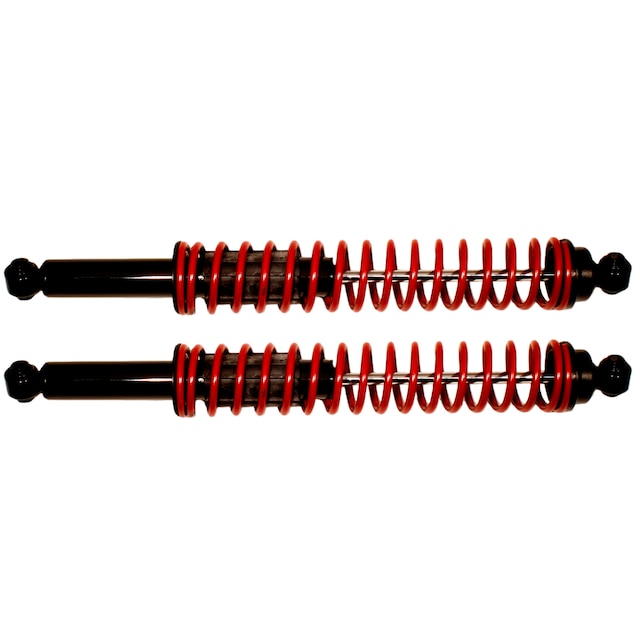
ACDelco Specialty Rear Spring Assisted Shock Absorber
Gold

ACDelco Specialty Rear Spring Assisted Shock Absorber

GM Part #88946589

ACDelco Part #519-30

MSRP$247.11*

ACDelco Specialty Spring Assist Shocks offer the benefits of both spring and shock technology to help reduce ride height loss in ongoing loaded conditions.

  • Constant rate front coil springs can help improve stability and maintain ride height
  • Variable rate rear coil springs provide 500 lbs (per pair) of load capacity. [Not to exceed vehicle GVWR (Gross Vehicle Weight Rating). Product does not increase payload.]
  • Seamless Drawn-Over-Mandrel (DOM) tubing decreases internal component wear, resulting in longer service life

About this product

ACDelco Specialty Spring Assist Shocks offer the benefits of both spring and shock technology to help reduce ride height loss in ongoing loaded conditions. These shocks produce strength, dependability, and long-life performance with both constant-rate front coil springs and variable-rate rear coil springs.

Warning WARNING: Cancer and Reproductive Harm - www.P65Warnings.ca.gov

  • Constant rate front coil springs can help improve stability and maintain ride height
  • Variable rate rear coil springs provide 500 lbs (per pair) of load capacity. [Not to exceed vehicle GVWR (Gross Vehicle Weight Rating). Product does not increase payload.]
  • Seamless Drawn-Over-Mandrel (DOM) tubing decreases internal component wear, resulting in longer service life
  • Super finished, chromed, piston rod provides anti-corrosion properties, a more consistent wear surface, proper seal lubrication, and longer product life
  • Real-world tested to ensure that the shocks will fit intended vehicles and applications

Mounting Hardware IncludedNo
Boot IncludedNo
Gas ChargedNo
Compressed Length14.88 in / 377.952 mm
ClassificationGold
Shock Stroke9.36 in / 237.74 mm
Shock Absorber Body End Measuring PointRing Center
Shock Absorber Rod End Measuring PointRing Center

12 Months/Unlimited Miles Limited Warranty for Parts (plus Labor if installed by a GM dealer)

Please visit our warranty page on Gmparts.com for full warranty details.

To inspect your shocks and struts to gauge wear, check for:

  • Brakes
  • Tie rods
  • Ball joints
  • Tires
  • Leaking oil or wetness along the body of the shock or strut.
  • Broken mounts, worn or missing bushings.
  • Broken, damaged, or missing mounting hardware.
  • Severely dented reservoir tube, bent or scratched piston rod.
  • Cupped tire wear.
  • Damaged strut body springs, seats, and bushings.
  • Defective strut bearing or missing plate.

Uneven patches of wear on the edges of your tire can be a sign of weak ride control (shocks or struts). This wear, called cupping, appears as scalloped dips around the surface of the tread. Other signs it could be time to replace your shocks or struts include:

  • There is excessive nose dive while braking
  • Your vehicle has 'acceleration squat'
  • Your vehicle does not return to a neutral position
  • Your steering pulls
  • There is a strut mount or bearing noise
  • Your ride is harsh, bumpy or shaky
  • Your vehicle bounces excessively
  • Your vehicle veers in side winds
  • Your vehicle leans or sways while turning
  • Your vehicle bounces excessively after hitting a bump
  • Your vehicle bottoms out
  • If your vehicle's height seems lower than normal when measured
  • If you notice fluid leakage from your vehicle's shocks or struts
  • If your vehicle's shocks or struts have dented or heavily scratched housings or mounts

ModelBody StyleTrimYear(s)
Silverado 15001999, 2000, 2001, 2002, 2003, 2004, 2005, 2006, 2007, 2008, 2009, 2010, 2011, 2012, 2013, 2014, 2015, 2016, 2017, 2018, 2019, 2020
Silverado 1500 Classic2007
Silverado 1500 LD2019
Silverado 2500 HD2011, 2012, 2013, 2014, 2015, 2016, 2017, 2018, 2019, 2020
Silverado 3500 HD2011, 2012, 2013, 2014, 2015, 2016, 2017, 2018, 2019, 2020

Frequently Asked Questions

Yes, though shocks and struts perform a similar function, they vary greatly in their design. Struts are an integral part of a vehicle's suspension system, providing structural support for the vehicle and, as such, are a safety subsystem. Shocks work separately from any structural function, simply absorbing and damping the bumps from the road.

Yes, all shocks and struts use hydraulic fluid (oil) to control damping. A gas charged shock or strut uses high-pressure nitrogen gas to reduce oil foaming during high-speed damping, and therefore maintains performance.

Yes, it is possible to do a quick check at home for wear on your vehicle's shocks or struts. You can look for any physical damage to the shock or strut housing or any leaking - this is especially common on rear units that tend to have stones kicked up by the front wheels. You can also perform a bounce test by taking each corner of the vehicle and pushing down hard. The corner should drop, rise and settle again. If the body continues to move up and down, there's a good chance your shocks need to be replaced. Though these home tests can indicate worn shocks or struts, it is also recommended that you take your vehicle to a qualified service technician and let them do a thorough inspection every 12 months or 12,000 miles.

Yes, if you are replacing your vehicle's struts. However, it is not necessary to get your vehicle aligned when replacing your vehicle's shocks unless there was or is a previous issue.

Yes, it is important to choose the correct shock or strut for your vehicle model and year, as well as for the location in the vehicle.